Thursday, December 15, 2016

Wikipedia pages for clinical trials

What would add value to have on Wikipedia pages for clinical trials? How could they support for example in recruiting and retaining patients? How could the underlying structured data in Wikidata be useful?
I had hoped to explore these questions during an internal innovation day. However, I had the chance to look more into another interesting thing: Jupyter Notebooks. Something I have been eager to do since last summer.

Anyhow, I hope to get involved in this interesting during 2017. I see great opportunities to both contribute and leverage from this in the work I do internally on a master list for clinical studies. I have started by engaging in two issues: Normalize study_phase values see a Issue on OpenTrials Git and also in a discussion about study identifiers (OpenTrials issue on github). Below some background to having clinical trials on Wikipedia, and in the data backbone called Wikdata, and also a note about OpenTrials.
Today (November 2016) a few studies have Wikipedia pages e.g. Lilly's PARAMOUNT study. 16 studies, including the Lilly study, are typed as Clinical Trial (Q30612) in Wikidata (SPARQL query). The Wikidata identifier for the Lilly study is Q17148583 and its URI is
http://www.wikidata.org/entity/Q17148583​ 

Wikidata is the backbone of Wikpedia where the entities behind Wikipedia pages are registered, such as compounds e.g. the Wikidata entity rosuvastatin (Q415159)hold some of the core structured data behind the infobox to the right on the Wikipedia page for Rosuvastatin
Wikidata entity and Wikipedia page for Rosuvastatin (also know as Crestor) 

Examples of structured data for Rosuvastatin in Wikidata: it is classified as a pharmaceutical drug (Q12140), and is a subclass of statin (Q954845) and what ATC code it has a property (P267). The structured data in Wikidata can be queries using SPARQL, a queary language for data structured as so calles RDF. The live SPARQL query to get the ATC codes for statins.
Live link to the SPARQL example live via: http://tinyurl.com/hd4f3x7

The data for drugs and chemical compounds are sourced from Drugbank using a so called bot (see A simple way to write Wikidata bots [blog post] and Drug and Chemical compound items in Wikidata as a data source for Wikipedia infoboxes[video]).

There are plans to integrate OpenTrials info into WikiData. That is, all studies registered in CT.gov/EudraCT, available via OpenTrials Explorer. For more info about OpenTrial see my recent blog pos​t.

A first part of that work is to develop a Data model i Wikidata for Trials. using the data elements for ClinicalTrials.gov. One example is how the NCT number, the identifier of studies, have been defined as a WikiData property (P3098) with statements about it such as the Format as a regular expression: NCT(\d{8}) and properties describing clinical trials like study phases.

Saturday, November 5, 2016

OpenTrials

I have followed the development of OpenTrials (@opentrials) since Ben Goldacre's (@bengoldacre) first comments about the lack of an open infrastructure to improve the sharing of information about clinical trials. See my blog post from 2013 Talking to machines.

It was nice to be able to give some initial feedback on the human user interface earlier this year. And very happy to see the API for programmatic data access. In this blog post I ask for some clarifications about Study URIs as a key enabler to link information about studies.

Intro to OpenTrials

I couldn't make it to the recent Hack day in Berlin just before beta version was launched at the World Health Summit. But it was great to follow the two events via the Twitter feed.

For a short intro to OpenTrials, watch this short video from the launch with Ben Goldacre.


Human user access and Programmatic data access

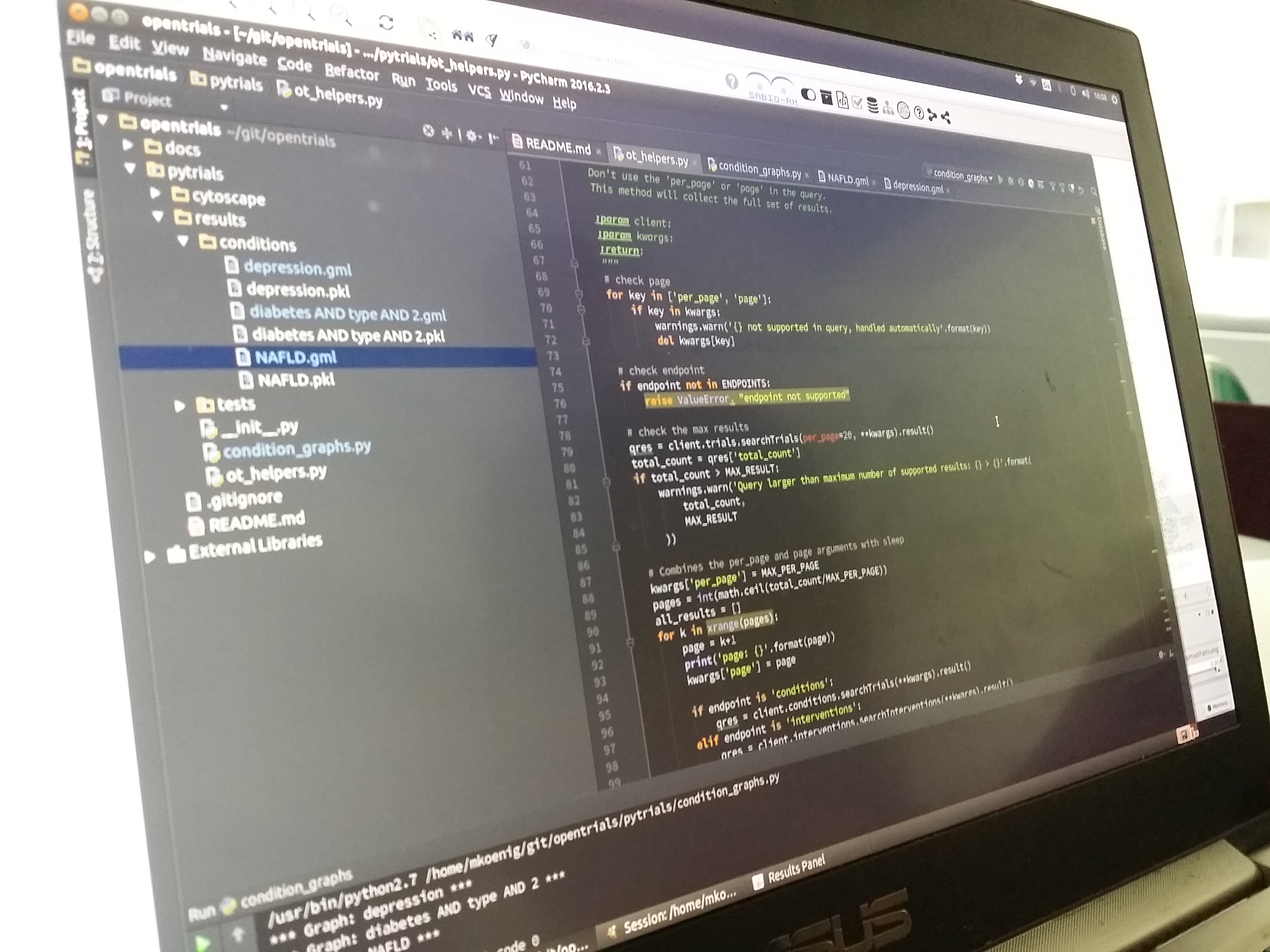
The user access to search the 300.000+ trials is via https://explorer.opentrials.net/. For programmatic access via APIs I find the blog post from the hack day excellent. It includes links to the API documentation (in Swagger), to a notebook showing sample code (Python) and to another example using R.

Code from the OpenTrials Hack Day in Berlin (photo by benmeg / CC BY)
I point colleagues in industry to this, and also to the OpenFDA, as two great examples of access to data both for humans and for programs. We have lots to learn from these two open data initatives, both when we define requirements and develop solutions.

I was also glad to see a comment from Ben Meghreblian (@benmeg), OpenTrials community manager, in an interview for the AllTrials initative the other day: "While API access is very useful, the best way a registry can offer its entire database is as a regular download, similar to what the FDA does with its OpenFDA website."

Study URIs

In the same interview Ben also concluded:
One thing we (IMHO), both in open data initatives and in industry, "need to spend a little on making sure the information is discoverable, machine readable, and impactful" is to establish persistent URIs as Identifiers of studies. So, instead of a text string such as "D5135C00001" as a secondary/sponsor identifier in e.g. CT.gov. I am pushing for study http-based URIs such as:

http://clinicaltrials.astrazeneca.net/study/D5135C00001

A first step is an internal process to assign URIs to both old and new studies, and also an internal study look-up API service. This study lock-up API provide basic study descriptions, such as study phase and acronym and is presented on a study "home" page with the same http address as the URL. On this page we also provide other identifiers for the same study e.g. CT.gov's NCT number: "NCT01732822" and link to it using the URL.

https://clinicaltrials.gov/ct2/show/NCT01732822

I have argued for study URIs from CT.gov but my understanding from interactions with some of the people behind it - they see their URLs as pragmatic, persistent study URIs. So Study URIs = study Page URLs.

I would like to also include the identifier for the same study represented in OpenTrials. Either as a study URI distinct from the study page URL, or deliberately using the same http schema for them. I may think the current ones are locating study pages (URLs) rather than identifying studies (URIs), for example:

https://explorer.opentrials.net/trials/9b48fd6a-2c6c-4455-bcc2-b1aff574298e

It would be great to have some clarifications about this. What I would like to have are namespaces for study identifiers (e.g. azct, nct, and opentrials) so I make assertions like these about the same study.

<azct:D5135C00001> <owl:sameAs> <nct:NCT01732822>
<azct:D5135C00001> <owl:sameAs> <opentrials:9b48fd6a-2c6c-4455-bcc2-b1aff574298e> 

<azct:D5135C00001> <azct:hasAcronym> "EUCLID"

I have also posted this as an issue (#552) on OpenTrials Github

Sunday, May 22, 2016

Awesome graphic as Graphs

The classic continuum from Data via Information to Knowledge is nicely visualized in a three part graphic. I've seen it shared many times the last couple of years on Twitter and LinkedIn. Today I saw it extended with Insight and Wisdom. It made it even more awesome.

Original graphic by Hugh MacLeod @hughcards
extended by David Sommerville @smrvl  

It was my friend and former colleague Martin Börjesson @futuramb that did a Re-Tweet of a tweet from John Hagel @jhagel, management consultant and author. It took me to the creator of the original graphic, Hugh MacLeod @hughcards, cartoonist and co-founder of @gapingvoid. The extension of it is done by David Sommerville @smrvl Digital Design Director for @TheAtlantic.

So, I started to think about representing the five pieces as executable and querayable graphs:

  • 1 DataPoint class
  • 21 DataPoints
  • 2 InfoClasses (represented by the green and lilac labels) 
  • 21 Classifications 
  • 1 type of Relationship
  • 18 relationsships
  • 1 new InfoClass (yellow) 
  • 2 new Classifications
  • 1 Relationship Query

RDF triples, RDF Schema and SPARQL would be one option.

Neo4j Property Graph and Cypher, another option.

Well, will see if I can find the time to do it, or convince some graphs and linked data friends to have a go at it :-)


Thursday, May 19, 2016

Global, persistent and resolvable identifiers for clinical data

Yesterday two thought leaders in clinical data standards publised great blog posts. Dave Ibersen-Hurst (@Assero_UK) and  Armando Oliva (@nomini). Dave's post has the title Wear Sunscreen but it's really about "CDISC 2.0". Armando's post has the title Improving the Study Data Tabulation Model

Discussions threads on Twitter and LinkedIn today made me write this post about one the many great proposals in the two blog posts: 1. SDTM should incorporate unique identifiers for each record in each domain.

In today's clinical data standards for 2-dimensional/tabular data exchange, e.g. CDISC SDTM, keys are either natural keys, e.g. STUDYID, USUBJID, LBTESTCD in a dataset of labdata according to SDTM, or surrogat keys, e.g LBSEQ. A define.xml file should be the source for study specific Key Variables for each dataset. For more details about SDTM keys and the challenges of this see Duplicate records - it may be a good time to contact your data management team, PharmaSUG 2016, Sergiy Sirichenko and Max Kanevsky (@pinnacle_21)

Armando details the proposal in his blog post as he says that the identifiers should be "globally unique".
This is a discussion I have looked forward to since I urged CDISC to consider semantic web standards and linked data principles in my presentation at CDISC EU conference in 2011.

Linking Clinical Data Standards
My presentation at CDISC EU Interchange 2011
I now see how smart programmers and informatians use checksums as record identifiers as a practical way to get around this problem and simplify the integration and reviewing of clinical data.

A phrase we often use talking about linking data and semantic web standards is: "globally, persistent and resolvable identifiers".

  • A http URI schema makes identifiers possible to resolve. An example of the URI that has a resolver service is http://data.ordnancesurvey.co.uk/id/postcodeunit/SO160AS the URI for the UK postcode SO160AS 1). 
  • While the URIs assigned to CDISC standard items such as http://rdf.cdisc.org/std/sdtmig-3-1-3#Column.LB.LBSTRES for the standard lab result variable in CDISC SDTM do (yet) not resolve.

So how would a URI look like for a single data point in a clinical study? HL7 FHIR use so called UUID. Trusty URI:s use hash values "URIs that contain a certain kind of hash value that can be used to verify the respective resource" http://trustyuri.net/ 

I am eager to learn more about the potential of using URIs in combinations with Blockchains. This presentation on using blockchain technology and semantic standards for provenance across the supply chain made me think ...


... about Semantic blockchains in the Clinical Data Supply Chain. With identifiers assigned to each data point through the the supply chain of clinical data captured in EHR and smartphones, fed into clinical trial records, aggregated into summary level TLFs and later on included in secondary use analyses.

Thoughts?

1) https://www.ordnancesurvey.co.uk/education-research/research/linked-data-web.html 
2) CDISC2RDF see https://github.com/phuse-org/rdf.cdisc.org

Friday, May 6, 2016

Twitter Feeds and Blog posts from Conferences

Conferences is a great way to meet interesting people and learn new things. Always nicest when you can attend IRL but interesting also following remotely via Twitter feeds, live blogging and reports and presentations blog post.

Conference Live Blogging

When I can attend conferences IRL I like to take notes using Twitter and I try to gather links and tweets using Storify as a kind of live blogging. Check out Storify/kerfors from events such as the recent Linked Data in Sweden, 2016 (ldsv2016) and HL7 FHIR workshops at Vitails, eHealth conference (Vitails2016).

Me in action live blogging

When I can not attend I like to follow conferences on  a distance and read peoples blog reports.

This week I've been following the great #csvconf feed from "a data conference that's not literally about CSV file format but rather what CSV represents to our community: data interoperability, hackability, simplicity,etc" The most interesting Twitter feeds from onferences I've seen so far.
Many thanks to some of the people tweeting from the event: , @_inunddata, @EmilyGarfield (Emily also posted some very nice drawings from the event.)


Conference Reports as blog posts

The recent CDISC Europe conference in Vienna #CDISCEurope did have a pretty thin feed but with some great tweets from Magnus Wallberg (@CMWallberg), Technology Evangelist at WHO Uppsala Monitoring Center, posted a few tweets.
Magnus also wrote an excellent report as a blog post: A great mix of standards and great visions when CDISC met in Vienna

Update: Just after I published this blog post I saw Wayne Kubick's (@WayneKubick), CTO for  HL7 and former CTO for CDISC, blog post HL7’s FHIR and BioPharma and article in Applied Clinical Trial: Building on FHIR for Pharmaceutical Research from a HL7 event I recently followed: Partners in Interoperability workshop in Washington DC.

Conference Presentations accompanying blog posts 

I also very much like when presenters quickly post their conference presentations on e.g. Slideshare. And it's also very nice to see accompanying blog posts with the speakers notes and additional material. I very much liked Dave Iberson-Hurst (@assero_UK) blog post with his CDISC Europe presentation this year. It is a post on his Semantic Web & Metadata series: CDISC Standards: Assessing the Impact of Change

I tried something similar when I wrote a blog post to prepare for my presentation "Linked Data efforts for data standards in biopharma and healthcare" at the Linked Data in Sweden, 2016 meeting a week ago: Linked Data in Sweden 2016


Thursday, April 21, 2016

Linked Data in Sweden 2016

It's time for the 5th "Linked Data in Sweden" event, Tuesday 26 April. Last year I was organizing the meeting in Gothenburg together with Fredrik Landqvist. This year we are back in Stockholm, this time at the Royal Armoury. I just learned that it is the oldest museum in Sweden. It was established by King Gustav II Adolph in 1628.

Several interesting presentations on the agenda from e.g Scania, Nobel Media, Wikimedia, Findwise and National Library of Sweden. I will give a short update on Linked Data efforts for data standards in biopharma and healthcare. So, I have started to think about things I would like to cover and will tweet an item per day to things I find interesting. Below the emerging list of links and a video presentation per item. Not much spare time, so I will shape them into a couple of slides on the train up to Stockholm, see slides in the end of this blog post.

Standards represented as Linked Data

The first items on my list are examples of when the authoritative sources of the content, in this case traditional standard organisations, publish linked data versions of their own content. This is very much what I was hoping for in my key at the Semantic Web Applications Tools for Life Sciences (SWAT4LS) workshop in late 2013: Pushing back, standards and standard organizations in a Semantic Web enabled world.
  • CDISC in RDF
  • HL7 FHIR in RDF
  • MeSH in RDF
  • ICD-11 in OWL
  • Others standards e.g. ATC, WHO Drug and MedDRA

CDISC in RDF

In 2011 I presented; Linking Clinical Data Standards, at the CDISC (Clinical Data Interchange Standards Consortium) EU conference in Brussels. A year later, in Stockholm, Frederik Malfait (IMOS Consulting and consult at Roche) and I together presented Semantic models for CDISC based standard and metadata management. At the 2nd Linked Data in Sweden meeting in 2013 I presented; Länkade kliniska data standards (Linked clinical data standards).

The same spring the CTO of CDISC, Wayne Kubick, agreed to make this a task for the PhUSE organisation (PhUSE Association Programming Pharmaceutical Users Software Exchange). The PhUSE Semantic Technology project started later that year.


Overview of PhUSE Semantic Technology Project
by Frederik Malfait (21:16 - 37:00)

In the summer 2015 CDISC published their standards in RDF.  In the future, representation of CDISC standards in RDF will be one of the outputs of CDISC's metadata registry (SHARE).

HL7 FHIR in RDF

The Fast Healthcare Interoperability Resources (FHIR, pronounced "fire") proposed standard describing data formats and elements (known as "resources"). It is an Application Programming Interface (API) for exchanging Electronic health records. The standard was created by the Health Level Seven International (HL7) health-care standards organization. And it is hot! I recently attended a FHIR workshop organised by HL7 Sweden at the Swedish eHealth conference Vitalis (see my Storify Vitalis2016).


The HL7 FHIR project and the W3C Semantic Web Health Care and Life Sciences Interest Group work on RDF representations of FHIR. The HL7 work lead by Graham Grieve, one of the creators of FHIR, and the W3C HCLS group lead by, David Both the initiator of the so called Yosemite project, will be aligned.


MeSH in RDF

The Medical Subject Headings (MeSH) is the National Library of Medicine's controlled vocabulary thesaurus. It is used to index the biomedical journals. The rational and design of MESH in RDF is described in a good article: Desiderata for an authoritative Representation of MeSH in RDF


ICD-11 in OWL

The 11th revision of the International Classification of Diseases (ICD-11) is based on a content model encoded in OWL that takes it beyond the long list of terms in ICD10. Excellent introduction by Mark Musen to both ICD11 and to how the ontology tool called iCAT, based on WebProtege, has been used to represent ICD-11. While most editors want to stick to Excel spread sheets. This is a shared experience for all data standards mentioned here.


Other standards e.g. ATC, WHO Drug, MedDRA

There are several other standards I would like to see RDF/OWL versions of  to make our use of them in biopharma more robust. For example ATC (Anatomical Therapeutic Chemical Classification System), WHO Drug Dictionary and MedDRA (Medical Dictionary for Regulatory Activities). Early 2015 I was invited to WHO Uppsala Monitoring Center to talk about the value of this.


In the same way as it took CDISC almost 5 years, from early ideas on using semantic web standards and linked data principles to actually applying them, I think it will take some years more before we have:"Standardized the Standards", quote from David Booth leading the Yosemite project (see below).

New initiatives outside the traditional standard organisations

Here a couple of interesting initiatives I wanted to also cover but will probably not have the time to do. 

See my Storify LDSV2016 with notes and links from the event.

And here are the slides for my presentation in the afternoon that I did put together on the train from Gothenburg to Stockholm this morning.


Wednesday, December 9, 2015

SWAT4LS 2015 Industry stream

It's been a great first day at SWAT4LS and I have been buying a few books in the lovely Cambridge University bookstore and had a nice conference dinner.

I'm now preparing for tomorrow's task to be the chair for the industry stream in SWAT4LS (see my previous blog post for more information about this event). So, here's a list of the 6 abstracts, companies and projects/tools that I'll introduce tomorrow morning:
  1. The BioHub Knowledge Base: Ontology and Repository for Sustainable BiosourcingText Mining/NLP research group within the School of Computer Science at the University of Manchester together with UniLever, BioHub Knowledge Base (BioHubKB)
  2. Customizing “General SPARQL” for visualisation of in-house data in CytoscapeGeneral BioinformaticsGeneral SPARQL
  3. GraphScope – smart data access for the life sciencesSearchHaus,  GraphScope
  4. Semantic Technologies Make Sense for Life SciencesSmartLogic
  5. Advancing Knowledge Discovery for Alzheimer’s Disease: The Alzforum ExperienceAlzforum
  6. Everybody a Translational Data ScientistOntoforceDISQOVER 

Tuesday, December 1, 2015

SWAT4LS 2015

Monday, 7th December, I will fly to Cambridge to attend the Semantic Web Applications and Tools for Life Sciences (SWAT4LS) conference and also visit colleagues at the new AstraZeneca site. The conference programme looks interesting and the venue, Clare College, fantastic ("Harry-Potter-land" was my husband's comment when he saw the pictures :-).


I am very glad to be the chair for the Industry session on Wednesday morning. Here are a few items on the programme I find extra interesting, from my clinical and RWE data perspective:
Will be great fun to meet friends and colleagues in the Semantic Web community.

Checkout my Storify: SWAT4LS2015

Thursday, June 25, 2015

Jupyter Notebooks


Last week I followed the feed from the Spark Summit 2015 event and several tweets talked about using Notebooks. Two tweets especially:
So I got curios in Jupyter, the lab notebooks used in the edX/DataBricks MOOC I'm following (Introduction to Big Data with Apache Spark). And yes, I do agree with Paco Nathan (@pacoid) and Edd Dumbill (@edd); Notebooks do look like a real game changer:  
  • VisiCalc and Lous 1-2-3 in the early 80ies. 
  • Mosaic and Netscape in the mid 90ies. 
  • I get a similar feeling now, in the mid 2010ies, when I see Jupyter Notebooks.
    (Yes, I know it's old news for all Mathematica users :)

The first 20 mins of this great video with Min Ragan-Kelley (@minrk) one of the core contributor to IPython and now to Jupyter, he gives a nice intro and in the following 30 mins he describes several cool examples of Notebooks, e.g. the CodeNeuro notebooks using Thunder based on Spark.


Excellent podcast interview with two other key contributors to iPython/Jupyter: Brian Granger (@ellisonbg) and Fernando Perez (@fperez_org)


Hmm, I need to think more about the combinations of Notebooks (reproducible research) and Linked Data (processable data) ... ...


Wednesday, April 22, 2015

CSVW for Tabular Clinical Trial Data and Metadata


W3C has developed a set of working drafts for tabular data and metadata called CSV on the Web (CSVW) and are now seeking comments and implementations.

The drafts describes:
  • Metadata vocabular for tabular data
    A JSON-based format for expressing metadata about tabular data to inform validation, conversion, display and data entry for tabular data
  • Model for tabular data and metadata
    An abstract model for tabular data, and how to locate metadata that enables users to better understand what the data holds; this specification also contains non-normative guidance on how to parse CSV files.
  • Procedures and rules to be applied when converting tabular data into JSON and RDF 
These are based on a series of use cases and recommendations including for example Publication of National Statistics and Analyzing Scientific Spreadsheets. I can see some interesting opportunities in this for tabular Clinical Trial Datasets.

A small example

Check out Ed Summers' (@edsu) very nice, small csvw example mentioning one of the authors of the drafts; Dan Brickley (@danbri, Developer Advocate at Google). Below the CSV example, related Metadata and the Annotated, linked data.

CSV
isbn,title,author
0470402377,"Bricklin on Technology","Dan Bricklin"

Metadata
{
  "@context": {
    "@vocab": "http://www.w3.org/ns/csvw#", 
    "dc": "http://purl.org/dc/terms/"
  }, 
  "@type": "Table", 
  "url": "example.csv",
  "dc:creator": "Dan Bricklin", 
  "dc:title": "My Spreadsheet", 
  "dc:modified": "2014-05-09T15:44:58Z", 
  "dc:publisher": "My Books", 
  "tableSchema": {
    "aboutUrl": "http://librarything.com/isbn/{isbn}",
    "primaryKey": "isbn",
    "columns": [
      {
        "name": "isbn",
        "titles": "ISBN-10",
        "datatype": "string",
        "unique": true,
        "propertyUrl": "http://purl.org/dc/terms/identifier"
      },
      {
        "name": "title", 
        "titles": "Book Title",
        "datatype": "string", 
        "propertyUrl": "http://purl.org/dc/terms/title"
      },
      {
        "name": "author",
        "titles": "Book Author",
        "datatype": "string",
        "propertyUrl": "http://purl.org/dc/terms/creator"
      }
    ]
  }
}


Annotated, linked data 
(RDF modeled serialized in JSON-LD)
  "@context": {
    "csvw": "http://www.w3.org/ns/csvw#",
    "dc": "http://purl.org/dc/terms/",
    "prov": "http://www.w3.org/ns/prov#",
    "xsd": "http://www.w3.org/2001/XMLSchema#"
  },
  "@graph": [
    {
      "@id": "_:g69960879269460",
      "@type": "prov:Usage",
      "prov:entity": {
        "@id": "example.csv-metadata.json"
      },
      "prov:hadRole": {
        "@id": "csvw:tabularMetadata"
      }
    },
    {
      "@id": "_:g69960879270660",
      "@type": "prov:Usage",
      "prov:entity": {
        "@id": "example.csv"
      },
      "prov:hadRole": {
        "@id": "csvw:csvEncodedTabularData"
      }
    },
    {
      "@id": "_:g69960879273280",
      "@type": "prov:Activity",
      "prov:endedAtTime": {
        "@value": "2015-04-22T20:21:11Z",
        "@type": "xsd:dateTime"
      },
      "prov:qualifiedUsage": [
        {
          "@id": "_:g69960879270660"
        },
        {
          "@id": "_:g69960879269460"
        }
      ],
      "prov:startedAtTime": {
        "@value": "2015-04-22T20:21:10Z",
        "@type": "xsd:dateTime"
      },
      "prov:wasAssociatedWith": {
        "@id": "http://rubygems.org/gems/rdf-tabular"
      }
    },
    {
      "@id": "_:g69960879277480",
      "@type": "csvw:Row",
      "csvw:describes": {
        "@id": "http://librarything.com/isbn/0470402377"
      },
      "csvw:rownum": {
        "@value": "1",
        "@type": "xsd:integer"
      },
      "csvw:url": {
        "@id": "#row=2"
      }
    },
    {
      "@id": "_:g69960879413940",
      "@type": "csvw:Table",
      "csvw:row": {
        "@id": "_:g69960879277480"
      },
      "csvw:url": {
        "@id": "example.csv"
      },
      "dc:creator": "Dan Bricklin",
      "dc:modified": "2014-05-09T15:44:58Z",
      "dc:publisher": "My Books",
      "dc:title": "My Spreadsheet"
    },
    {
      "@id": "_:g69960879425260",
      "@type": "csvw:TableGroup",
      "csvw:table": {
        "@id": "_:g69960879413940"
      },
      "prov:wasGeneratedBy": {
        "@id": "_:g69960879273280"
      }
    },
    {
      "@id": "http://librarything.com/isbn/0470402377",
      "dc:creator": "Dan Bricklin",
      "dc:identifier": "0470402377",
      "dc:title": "Bricklin on Technology"
    }
  ]
}


A clinical trial data example?

Tabular data has been the traditional way to organize how clinical trial data is captured, stored and submitted. So, I think that this would be very interesting to explore to be able to bind data to it's metadata in a similar way. That is to, make things like variable labels, date/time formats etc. explicit.
  • How could the metadata for a small, example of e.g. demographic data look like?
  • How would the annotated, linked data look for such a small example like?
I would love to see some early ideas on how this could be implemented in the two main language/environments we use today for clinical data: SAS and R. Similar to the early implementation of CSVW in Ruby described in a nice blog post from Greg Kellogg (@Gkelloggone of the authors of the drafts).

Such a first example I think would trigger an interesting ideas for best practices and potential extensions to the metadata vocabular and model, and also to the procedures and rules to create annotated JSON and RDF representations such as:
  • Templates for the URIs to be assigned to each captured and derived data point?
  • Representing implied formats in varchar fields such as dates and precision.
  • Making explicit the implied metadata from the actual data such as encoded labtest codes and units.
  • How to leverage the RDF schemas representing CDISC standards?
  • How to best use W3C's Provenance ontology to capture the life cycle of a data point in a clinical trial?
I think questions as these are important to address, especially in the context of transparency and reuse of clinical trial data, see also an earlier blog post: Clinical Trial Data Transparency and Linked Data.

So, I hope this blog post will spark some interesting responses from the SAS and R communities, and discussions in groups like CDISC and PhUSE Semantic Technology project.

Monday, February 16, 2015

Clinical Trial Data Transparency and Linked Data

I've with great interest been following the discussions about clinical trial transparency and sharing of clinical trial data for the last three years. More precisely - my first tweet about this is from early 2012:


There has been a lot of debates over these years of how much of results of clinical trial results being published - is 50% or much more? Journal article publications vs trial registries? A lot of issues around summary level data vs. patient level data, and around de-identification of data and redaction of documents etc.

All interesting topics but my interest in all of this is the opportunities in making data in, about and related to clinical trials, useful using semantic web standards and linked data principles. In the spring 2013 I wrote a post on my blog: Talking to Machines, about this after listening to Ben Goldacre, one of the key people behind the AllTrials initiative where he also acknowledged this:


Here are a couple of recent events, early 2015, related to Clinical Trial Data Transparency and Linked Data:
  • AAAS Panel on Innovations in Clinical Trial Registry
  • Public consultation EMA Clinical trial database
  • IoM report: Sharing Clinical Trial Data: Maximizing Benefits, Minimizing Risk

AAAS Panel on Innovations in Clinical Trial Registry

So, I really liked what I saw in the program for a session yesterday evening (15 February, 2015) from the American Association for the Advancement of Science annual meeting in San Jose (#AAASmtg) in a panel on Innovations in Clinical Trial Registers
Documents relating to trials -- protocols, regulatory summaries of results, clinical study reports, consent forms, and patient information sheets -- are scattered in different places. It is difficult to track the information that is available, in order to audit for gaps in information and for doctors and regulators to be sure they have all the information they need to make decisions about medicines. There is an unprecedented opportunity to refine how clinical trial data are shared and linked.

Public consultation EMA Clinical trial database

This is similar to what I wrote last week when I tried to "act courageously" and responded to "the public consultation on how the transparency rules of the European Clinical Trial Regulation will be applied in the new clinical trial database is launched by the European Medicines Agency (EMA)."
Make use of modern data standards and access methods to make the access to the clinical trial database developer-friendly, data machine-processable and the trials and their components linkable. Leverage initiatives and use principles, such as CDISC Standards in RDF (under review), that uses modern data standards from W3C stack of semantic web standards, openFDA that uses developer-friendly REST APIs JSON (openFDA API reference), and the linked data principles.

IoM report: Sharing Clinical Trial Data: Maximizing Benefits, Minimizing Risk

A couple of weeks ago the Institute of Medicine (IOM) released an excellent report: Sharing Clinical Trial Data: Maximizing Benefits, Minimizing Risk.

Short summary, as I interpret the core message of the report: Instead of just designing and planning a study, scientists need to plan and document how they're going to share the data from that study so that its usable to others who may want to re-analyze it.

The report has a well written section on “legacy trials” and an interesting listing of challenges:

Infrastructure challenges—Currently there are insufficient platforms to store and manage clinical trial data under a variety of access models. 
Technological challenges—Current data sharing platforms are not consistently discoverable, searchable, and interoperable. Special attention is needed to the development and adoption of common protocol data models and common data elements to ensure meaningful computation across disparate trials and databases. A federated query system of “bringing the data to the question” may offer effective ways of achieving the benefits of sharing clinical trial data while mitigating its risks. 
Workforce challenges—A sufficient workforce with the skills and knowledge to manage the operational and technical aspects of data sharing needs to be developed. 
Sustainability challenges—Currently the costs of data sharing are borne by a small subset of sponsors, funders, and clinical trialists; for data sharing to be sustainable, costs will need to be distributed equitably across both data generators and users.

And for a ”clinical trial data and metadata nerd” as me this is like music :-)

Just because data are accessible does not mean they are usable. Data are usable only if an investigator can search and retrieve them, can make sense of them, and can analyze them within a single trial or combine them across multiple trials. Given the large volume of data anticipated from the sharing of clinical trial data, the data must be in a computable form amenable to automated methods of search, analysis, and visualization.


To ensure such computability, data cannot be shared only as document files (e.g., PDF, Word). Rather, data must be in electronic databases that clearly specify the meaning of the data so that the database can respond correctly to queries. If data are spread over more than one database, the meaning of the data must be compatible across databases; otherwise, queries cannot be executed at all, or are executable but elicit incorrect answers. In general, such compatibility requires the adoption of common data models that all results databases would either use or be compatible with.

Wednesday, November 5, 2014

ISWC2014 Trip Report

A few highlights from five intensive days at the International Semantic Web Conference (ISWC2014) in lovely Riva del Garda. See also my previous blog post Preparing for ISWC2014 and my live blog from all five days using Storify.

ISWC2014 Storify

Strong industry presence

ISWC is a research focused conference. However, this year it had a strong industry prescence with a full day Industry track, Semantic Developer workshop and many of the Lighning Talks came from industry. It was great to meet Business Analysts and Information Architects from large companies such as Roche, Genentech and NXP Semiconductors and also from small companies such as the Danish StatGroup.
  • All five Information Architects in the Data Standards Office at Roche / Genentech attended all five days to learn more about latest in semantic web research, especially traceability and provenance. Frederik Malfait, working for Roche and FDA/Phuse, described their RDF implementations of clinical trial data standards is the basis for a model driven architecture enabling computable protocols, component based authoring and automation of setting up clinical trial databases and generating submission datasets.
  • Marc Andersen, one of the two founders of StatGroup, presented the experience of the Pharmaceutical Users Software Exchange (PhUSE) developing a semantic representation of statistical results based on RDF and OWL. Providing clinical trial results as linked data will facilitate traceability, data sharing and integration, data mining and meta-analysis benefiting industry, regulatory authorities and the general public.
  • A business analyst described how NXP Semiconductor is making use of Semantic Web technology such as RDF and SPARQL to manage a product taxonomy for marketing purposes that forms the key navigation of the NXP website. 

Hot topics: Developer friendly, Linked Data Fragments, Provenance and Semantics for Sensors

  • The Semantic Developer Workshop and the conference program included many examples of RDF and SPARQL support in traditional programming languages, such as Java, Perl, C# and Javascript, as well as in data science languages, such as Python and R. The Semantic Developer of the Year, Kjetil Kernsmo, from Oslo University, presented RDF/Linked Data for Perl. JSON-LD was refereed to as the the developer-friendly serialization of RDF.
  • Many of the presentations described how they applied the Provenance standard from W3C for "information about entities, activities, and people involved in producing a piece of data or thing, which can be used to form assessments about its quality, reliability or trustworthiness." One example was how the standards had been used event based traceability in pharmaceutical supply chains via automated generation of linked pedigrees.
  • Semantics for Sensors for every-thing from smart building diagnostic,  traceability  in pharmaceuticals supply chain, and traffic diagnosis to predicting frost in vineyards on Tasmania.
  • "Everyone" talked about the work presented on the best awarded poster: Linked Data Fragments "so light-weight that even a Raspberry Pi can publish DBpedia (Wikipedia structured content) with high availability" http://fragments.dbpedia.org/ 

Best workshop paper award

It was very nice to present our joint EHR4CR, Open PHACTS, SALUS and W3C HCLS paper. It got a best paper award in the pre-conference workshop: Context, Interpretation and Meaning for the Semantic Web.

Other ISWC2014 reports

Tuesday, October 28, 2014

RDF as a Universal Healthcare Exchange Language

Here's a short post about a nice webinar serie: Yosemite Manifesto proposing RDF as a Universal Healthcare Exchange Language. It is provided by  Semantic Technology & Business (@semanticweb).

Here are a couple of tweets I posted during Part 1 (video and slides) with David Booth.


The Yosemite manifesto has been critized. I recommend a "very civil discussion, in the face of clear disagreement" between David Booth, Thomas Beale (@wolands_cat) and Dean Allemang (@WorkingOntology): RDF for universal health data exchange? Correcting some basic misconceptions…

I look forward to Part 2, Friday 7 November evening (8pm CET), when Conor Dowling, Caregraph will talk about: "Lab tests and results have many dimensions from substances measured to timing to the condition of a patient. This presentation will show how RDF is the best medium to fully capture this highly nuanced data."

Tuesday, October 14, 2014

Preparing for ISWC2014

Next week I’ll have the great pleasure to attend my first Int. Semantic Web Conference (ISWC). I've been  fascinated by the power of the semantic web stack of standards for many years. Standards all based on the RDF model to represent and link data, as well as schemas, models and terminologies. I heard Tim Berners-Lee talk about the Semantic Web for the first time at the WWW8 conference back in 1999 in Toronto, Canada.


13th International Semantic Web Conference, ISWC 2014,
will take place in Riva del Garda, Terentino, Italy
.

At ISWC2014 I’ll present a follow-up paper to the one I presented in early September at the Medical Informatics Europe conference (see my earlier blog post: Preparing for MIE2014). It is a joint paper with colleagus from IMI EHR4CR, Open PHACTS, FP7 SALUS, W3C HCLS. Now with more details on the use of nanopubs and linksets in A Justification-based Semantic Framework for Representing, Evaluating and Utilizing Terminology Mappings. It will be discussed on Sunday in a pre-conference workshop organized by Alasdair Gray (@gray_alasdair), Paul Groth (@pgroth) et al. Workshop on Context, Interpretation and Meaning

I'm also also looking forward to participate in the Semantic Statistics workshop to learn more about things like the Data Cube for statistical data. This is a highly relevant topic for FDA/PhUSE and CDISC as representing clinical trial analysis results data as RDF Data Cubes is a topic at the ongoing PhUSE conference (presentation from UCB) and at the upcoming CDISC Interchange (presentation from DIcore Group, LLC, SAS Data Submission Consulting Services).

Tuesday evening I’ve been asked by James Malone (@jamesmalone) from EBI to sit on a panel at the European Ontology Network (EUON) Town Hall meeting together with Mark Musen, Stanford Center for Biomedical Informatics Research (I’m star strucked ;-) (Started earlier this year at the 1st EUON workshop in Amsterdam.)

I’m looking forward to meet interesting people from the semantic web community, and also newcombers to the community from organizations such as WHO, Roche, and CDISC. Magnus Wallberg from Uppsala Monitoring Centre WHO, working on a API and  RDF project for Global ICSR statistics. Also from the FDA/PhUSE Semantic Technology project there will be presentations form Landen Bain, CDISC, and Frederik Malfait, Roche, will present at the Industry Track on Wednesday.

I’ll try to keep my Storify-ISWC2014 updated during the week with interesting tweets, links and notes. And I know the Twitter-tag #iswc2014 feed will be lively as I’ve followed several earlier ISWC conferences on a distance.  

Monday, August 25, 2014

Preparing for MIE2014

After a fantastic warm and sunny summer here in Sweden it's time for me to get prepared for the European Medical Informatics Conference - MIE2014, Istanbul, 31 Aug. to 3 Sept.


Our joint paper co-authored by members across the IMI EHR4CR, Open PHACTS, SALUS projects and W3C HCLS community describing "A Framework for Evaluating and Utilizing Medical Terminology Mappings" has been accepted. And I have got the opportunity to present it in the main conference on the 2th September. 


For me the paper started from some great discussions at ICBO (Int. Conference Biomedical Ontologies) in Montreal last year with Trish Whetzel (@TrishWhetzel) and Jim McCusker (@jpmccu) on the topic: "mappings are not sufficient - need the justifications for the mappings". We started to talk about using so called Nanopublications to capture the justification for the mapping for users to make better use of for example the mappings provided via the NCBO Bioportal.

When I came back from the ICBO conference I wrote a blog post outlining some more ideas on using Nanopublications and/or Linksets, both stemming from the IMI Open PHACTS project. Some nice comments and sharing of my blog post: Justifications of Mappings encourage me to work more on these ideas. My colleague in the EHR4CR project, Sajjad Hussain (+Sajjad Hussain), pointed me to a very interesting blog post: SALUS project on Terminology Mappings. After some great discussion over a lunch at the SWAT4LS conference in Edinburgh with Hong Sun, from SALUS, Charlie Mead and Eric Prud'hommeaux, from W3C HCLS, Alasdair Gray (@gray_alasdair) from Open PHACTS, and many more, Sajjad and I started to outline a paper decribing a framework combining solutions and ideas on evaluating and utilizing terminology mappings.

Beside presenting this paper I look forward to participate in an MIE2014 tutorial and workshop:
  • Tutorial on the IEEE 11073 Standards for Personal Health Devices (Wikipedia: ISO/IEEE_11073). This is a standard I have been looking into earlier. It nicely combines my interest in clinical trials and health care data standards together with my previous industrial PhD studies in Mobile Informatics (see the slides presenting my PhLic thesis from 2001: Mobile Newsmaking).
  • Workshop on Interoperability Challenges for enabling secondary use of Electronic Health Records — ICEH 2014 In this workshop I look foward to meet and talk with many including the great metadata and ontology experts Gokce Laleci Ertukmen and Anil Pacaci (@aasinaci), Software Research, Development and Consultancy, Turkey.

I hope to be able to use my Twitter (@kerfors) feed to share interesting things I learn about in the conference, and from the historic city of Istanbul. And gather tweets, links, photos from each day using Storify. In the same way as I have done from eralier conferences. 

So, have a look at my MIE2014 Storify for daily updates 31 Aug. to 3 Sept.

Friday, June 13, 2014

openFDA a Game Changer?

I’ve been fascinated by innovative people in the FDA organization since I had the pleasure to meet Dr Norman Stockbridge, the father of FDA’s Janus datawarehouse model, F2F back in 2005 in Washington, DC. 

So when I saw some early notes about an openFDA initiative in June 2013 and early 2014 I posted a couple of tweets.


In April I wrote a short blog post about openFDA. And, when I saw how the new Chief Health Informatics Officer at FDA, Taha Kass-Hout (@DrTaha_FDA) started to count down on Twitter a couple of weeks ago I got really excited. It was nice to follow the #hdpalooz feed on Twitter from the health care data event in early June when openFDA was launched.


And, also to see services that directly were picking up the first openFDA API and launced services and apps to search the 3.4 million adverse events, such as Research AE

For a brilliant intro to what sits behind the first openFDA API I recommend Alex Howard's (@digiphile) excellent article: openFDA launches open data platform for consumer protection openFDA launches open data platform for consumer protection.
"Instead of contracting with a huge systems integrator.. FDA worked with a tiny data science startup.. to harmonize the data, create a cutting-edge website, and write and release open source code for a data publishing platform for it [on GitHub]"

I think this will be a game changer for how we think about open data, open source and open communities in industry. And yes, I do think we will soon will see much more Open, and Linked Data from FDA, and hopefully also from EMA and across industry.

Kudos to the devlopers behind all of this great work,
e.g. Sean Herron (@seanherron) and  Brian Norris (@Geek_Nurse)