Sunday, January 8, 2012

"To-day we have naming of parts"

I like to explore associations people share with me when I describe something new to them. So, I was pleased the other day when a colleague in the UK shared the phrase that did stick in her head when I described the idea of URI:s (Uniform Resource Identifiers) and Linked Data: "To-day we have naming of parts".

So, after some googling I found the poem by Henry Reed (1914-1986), "Naming of Parts." New Statesman and Nation 24, no. 598 (8 August 1942).
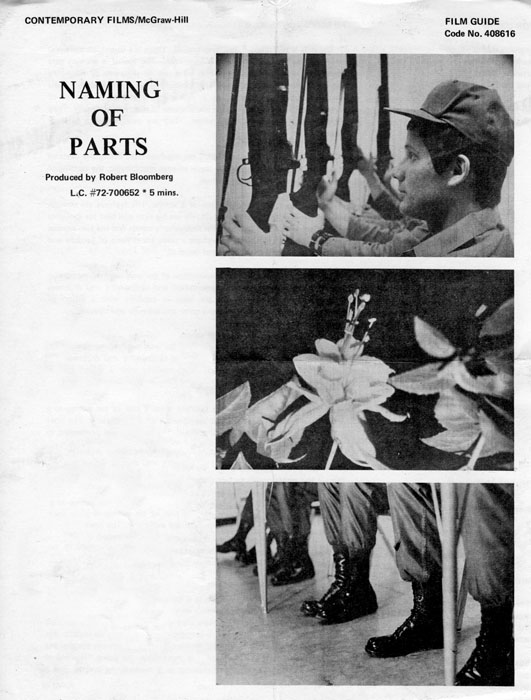
To-day we have naming of parts. Yesterday,
We had daily cleaning. And to-morrow morning,
We shall have what to do after firing. But to-day,
To-day we have naming of parts. Japonica
Glistens like coral in all of the neighboring gardens,
     And to-day we have naming of parts.

Hear Henry Reed and Frank Duncan read "Naming of parts" (mp3)


Through a very nice website; The Poetry of Henry Reed, I learned more about this World War II British poet, critic, translator, and radio dramatist. It helped me to better understand this wonderful, and sad, poem about the contrast between the world of weapons and the world of nature. 

Naming parts and other things
I also learned about an article (DOI:10.1038/nbt0102-27) in Nature BioTechnology (2002) using the first stanza in Henry Reeds' famous poem as its title. In the article a professor of genomics at the University of Manchester describes the identification of previously non-annotated genes in yeast.

And, I also found a blog post from 2009 that also used the first stanza in Henry Reed's poem in its title:
Naming of parts and other things. That is, David Bawken's (@David_Bawden) post on his nice blog: "The Occasional Informationist, irregular thoughts on the information sciences". In this post he describes a meeting with John Wilbanks (@wilbanks) at the British Library:
In his presentation of the need for annotation of digital reporting of scientific findings, Wilbanks commented simply that we need to call the same thing by the same name; this makes possible the semantic linking of information and data, the creation of ontologies, and so on, without which it will not be possible to share information across disciplinary and sub-disciplinary silos. 
He exemplified this by examples by simple – the various names for coffee in different languages – and complex – the variant terminology used in hundreds of datasets relating to polar climate change, and in over a thousand related to genomics.
There was another aspect to this point. What we call an information object in the digital world – DOIs and all the rest – is also fundamental; if we do not call these digital objects the same thing, we will have great difficulty in finding them.

Names of today
So, let me conclude this post with a couple of examples of naming parts and other things using names of today that is http-based URI:s. The three example URI:s are also three examples of large efforts to publishing linked data "about the named things":

  1. British Library's URI for the poet Henry Reed
    http://bnb.data.bl.uk/id/person/ReedHenry1914-1986
  2. Wikipedia's, i.e. DBpedia's, URI for the poet Henry Reed
    http://dbpedia.org/resource/Henry_Reed_%28poet%29
  3. The DOI for the the article about identifying genes in yeast turned into a URI by CrossRef
    http://dx.doi.org/10.1038/nbt0102-27

1. British Library publish metadata about bibliographic resources ("things") using Linked Data techniques and technologies. And part of that is to assign http-based URI:s to the creators. For a great introduction to the underlying model see the blog post: British Library Data Model: Overview by Tim Hodson (@timhodson).

So, for example the data model specifies that persons who are the identified creators of bibliographic resources, such as the poet Henry Reed (http://bnb.data.bl.uk/id/person/ReedHenry1914-1986), should be of the type Agent and Person according to the basic, and very often used vocabulary for linked data, called Friend of a Friend (FOAF).


2. A large part of the structured content published on Wikipedia pages is also made available as linked data called DBpedia. See this great article: How DBpedia Treats Wikipedia as a Database. The so called resources ("things") that the wikipedia pages describes are in DBpedia given http-based URI:s and each resource are typified using a thin model called the DBpedia ontology. 

So, here we can see that the poet Henry Reed is also identified in DBpedia (http://dbpedia.org/resource/Henry_Reed_%28poet%29) and described with the structured data from the Wikipedia page about him. Such as his birth date and death date, and also the fact that he is categorized using the concept 'English poets'. This concept also has a URI http://dbpedia.org/resource/Category:English_poets. So, we may have more than one URI for the same Henry Reed. These can be related to each other using the sameAs statement.


This is not yet done by the British Library, but I assume this will be done later as for example the Swedish Library catalogue relates their URI:s to DBpedia's.

Here is another URI, http://dbpedia.org/resource/Category:Firearm_components, for a categorization concept, and in the DBpedia interface you can see of list such resources ("things") and links to them using URI:s such as http://dbpedia.org/resource/Sling_%28firearms%29.


3. CrossRef has made metadata for 46 million Digital Object Identifiers (DOI) available as Linked Data. DOIs are used for publishing of uniquely identify electronic documents (largely scholarly journal articles). CrossRef is a consortium of roughly 3,000 publishers, and is a big player in the academic publishing marketplace.

So, here is the identifier of the article about identifying genes in yeast http://dx.doi.org/10.1038/nbt0102-27.

Kudos to my colleague for the opportunity for me to learn more this wonderful poem and for a great discussion.
To ReedingLessons the signature behind the great website about Henry Reed.
To @David_Bawden for his niceblog 
The Occasional Informationist.
And, finally, to @wilbanks a great source of inspiration.

Sunday, December 11, 2011

Linked Enterprise Data Patterns Workshop

Earlier this week I followed yet another event remotely. This time the workshop arranged by W3C on Linked Enterprise Data Patterns, in Cambridge, MA. So, I had some nice hours on the bus in the dark evenings and mornings over here in Sweden when I followed things on the:

Here's a couple of things I did find extra interesting:

An article on IBM developerWorks presented by Martin Nally: Toward a Basic Profile for Linked Data, A collection of best practices and a simple approach for a Linked Data architecture

New role proposed by Tim Berners-Lee (@timberners_lee) "Chief Identity Officer".

IBM DB2 will include RDF support sometime in 2012.

I have followed the work of Eric Prud'hommeaux, W3C, on access controls and policy medication to enable networks of parties across industry, health care, and academia to share sensitive data such as clinical records.
Two papers on identity and URI:s with interesting people as co-authors that I'll read in more detail:
And, finally, a quite interesting discussion on 'silo folks & data integration folks' between David Wood and Bradley P. Allen captured by Sandro Hawke (@Sandhawke) in the irc channel log/scribe from the first day.

davidw: Where RDF really shines is in crossing silos, connecting things where traditional approaches have left off. 
davidw: Some orgs that have succeeded well (DoD, O'Reilly), they built a new team and hire ontologists if they need them, they get consultants in, they build a skunk works to do that bit between the silos.  They leave the DBAs in place, because the DBA stuff still needs to get done.
davidw: And they have consultants/new team to build out that bridging infrastructure.  You're not going to convert your silo folks -- really good at silos -- into data integration folks. 
Allen: That's what we're doing, with a startup group, showing we can solve this interop problem. 
Allen: When people see this, they perk up, and want to know more.


Other blog posts from the conference:


Sunday, December 4, 2011

Large organisations using Semantic Web

Earlier his week the east version of the Semantic Tech & Biz Conference took place in Washington, DC. And I followed it via the #semtechbiz feed on Twitter. The activity in this feed was lower than at the much larger west version that took place in San Francisco early June. An event I also followed remotely, see my blog post: SemTech2011 report

Below I highlight one of the many case studies presented in the conference in Washington, DC, on the theme "here is what we did", that is what U.S. military (DoD) do in their so called Enterprise Information Web. Further down you find examples of what Chevron and Statoil did in the oil industry. In two side notes I wunder about the use of semantic technologies in Norway, and I am reminded of some explorative work I did ten years ago on Topic Maps and Published Subject Identifiers (PSI:s). 

Enterprise Information Web
One of the many case studies presented in the conference was the U.S. military (DoD Defense Information Systems Agency) Enterprise Information Web. In the recent RFI, Request for Interest, they write "the envisioned EIW is built on semantic web, which will allow better enterprise-wide collection, analysis and reporting of data necessary for managing personnel information and business systems, as well as protecting troops on the ground with crucial intelligence."

A YouTube video with Dennis E. Wisnosky, Chief Technical Officer and Chief Architect at DoD
See also: DoD
Turns to Semantic Web To Improve data Sharing

As being a non-American I do find it a bit hard to relate to DoD and some of the critical comments to the YouTube video. However, as I wrote in one of my tweets: 30+ years ago U.S. military needed Internet - now they use Semantic Web standards and Linked Data principles. And I think this video gives some really nice explanations.

How two large organisations in oil industry use semantic web
This week I also saw another interesting case study, that is how the semantic web standard OWL is used in the oil industry. In an interview with Roger Cutler, published on the W3C blog, he describes the typical situation in most large organisation where information "lives in different forms in number of different systems and is handled separately by different organizations with different data models", and he talks about how this traditionally have beed adressed:
People use point-to-point solutions or big data warehouses, but neither approach scales gracefully. Point-to-point solutions become very complex and hard to maintain. Data warehouses create replication issues and tend to be fragile. So, the possibility of a smarter, more agile, more cost-effective way of dealing with integration would have a great deal of value to us. The Semantic Web is not guaranteed to be the solution, but it looks plausible and we’d like to see if it lives up to its promise in practice.
I also noted that Roger Cutler, Research Consultant at Chevron Information Technology Company, talks about the "expressiveness and reasoning achievable with OWL". I like that because I sometimes hear comments a long the lines that OWL, and OWL2, is too complex and maybe not so useful in an industrial setting. In the interview Roger say:
We have demonstrated a case in which similar objectives were obtained in the context of an ontology with about fifteen lines of readily comprehensible rules and in a relational database context with over 1000 lines of pretty complex code.
I also see that there exists a W3C Oil, Gas and Chemicals Business Group also with an representative from Statoil, Jennifer Sampson. And I now also see an interesting case study presented by Jennifer at the SemTech conference in San Francisco: Semantic Technologies and Statoil's Integration Layer for Plant Information Systems.

Side note: Semantic technologies in Norway
The Statoil presentation looks really interesting and is a trigger for me to catch up with how semantic technologies are used in Norway. Have been thinking about that for some time. I visited Statoil's office in Stavanger a couple of years ago to talked about metadata standards. And I see some interesting signals that semantic technologies have much been more used in Norway than in Sweden.

Side note: Topic Maps and Published Subject Identifiers (PSI:s)
Back in 2002, before the OWL standard existed and Linked Data principles was defined, I supervised a master thesis with an Evaluation of Topic Maps for information navigation in cardiovascular research. Topic Maps is a semantic technology that has a strong presence in Norway. The master students I supervised worked together with Steve Pepper, the Topic Maps guru. A key learning I took away from some really good discussions back in 2002 with Steve, and also Lars Marius Garshol (@larsga), was the idea of Published Subject Identifiers (PSI:s). In a future blog post I will do a recap of PSI:s and try to relate it today's http-based URI:s as a one of the Linked Data principles.


Kudos to Bernadette Hyland (@BernHyland) and Dave Smith (@DruidSmith)
for their #semtechbiz tweets. And also to @semanticweb for the great news service:
"Voice of Semantic Web Technologies and Linked Data Business" and to the @W3C blog.


Sunday, October 23, 2011

Query Federation and Linked Closed Data

This is a blog post with highlights from the 10th International Semantic Web Conference taking place in Bonn, that I picked up while following the event on distance.

>> Updated 2 November with a presentation by Peter Haase on Fedbench, see below. And also with this the nice blog post by Ivan Herman's (the leader for W3C's Semantic Web work): Some notes on ISWC2011…

>> Updated 13 November with a link to a paper on federated search in life science, see below.

Today and tomorrow, Sunday - Monday 23-24 October, are the workshops days with 16 workshops arranged before the main conference. Through the day I have on and off been catching up on the busy Twitter feeds on my iPhone while being out walking in the nice weather on the West Coast of Sweden. And now in the evening I have picked up two things of that I did find extra interesting from an enterprise perspective on linked data and URI:s.

Query Federation
Being able to do federate querying of data from different internal and external data sources is a key capability required in an enterprise context. An interesting paper presented in the Consuming Linked Data Workshop describes how this can be done using the VOID standard (Vocabulary of Interlinked Datasets): SPLENDID: SPARQL Endpoint Federation Exploiting VOID Descriptions by Olaf Görlitz and Steffen Staab.

The paper use a scenario of researchers in the life science domain have numerous databases at hand which contain detailed information about pathways, genes, proteins, drugs and so forth. It describes and evaluate a framework called SPLENDID including an Index Manager, a Query Optimizer, and a Query Executor.

A take away highlighted in the Twitter feed from the presentation of the paper is the value of publishing VOID data for Linked Data set. The paper also includes references to an interesting product that I have spotted in other tweets earlier on: FedX, a framework for transparent access to Linked Data sources through a federation using optimization techniques. See also a recent discussion thread: SPARQL Federated Query Clients, on W3c's Linked Open Data email-list. I also find this paper from 2009 by key people in W3C's interest group for semantic web in life science highly relevant: A journey to Semantic Web query federation in the life science.

Later on in the conference a research paper was presented that I adress topic of central repositories vs. federated querying and processing


Linked Closed Data
In an enterprise context the recognition of the use of transparency and the value of open sharing of data is getting more and more traction. By applying the Linked Data principles corporations can enable meaningful use of data. See my previous blog post on Corporate Transparency and Linked Data. At the same time there are of course datasets for which access to and use of the data is subject to legal, business, data privacy or ethical restrictions which go beyond attribution and share-alike obligations.

A vision paper presented at the Consuming Linked Data Workshop outlines A research agenda for Linked Close Data by  Marcus Cobden, Jennifer Black, Nicholas Gibbins, Les Carr, and Nigel
Shadbolt. The authors defines  Linked Closed Data as Semantic Web datasets which are published in accordance with Linked Data principles, but which include access and licence restriction.

I was glad to see that Ivan Herman in his blog post also highlight this: "we can and we should speak about Linked Closed Data alongside Linked Open Data is important if we want the Semantic Web to be adopted and used by the enterprise world as well."


Thanks Kudos to @juansequeda and @ivan_herman for your great tweets today.
(While writing this blog post I can see on Twitter that the folks at the conference in Bonn now have a linked data gather and getting ready to play "#semanticbeerpong" :) For me it's time for a cup of tea instead ...)

Monday, September 19, 2011

Semantic Interoperability in 4 tweets


Thursday, September 1, 2011

ICBO2011, Disease terminologies and ontologies

This is my fourth blog post from the International Conference on Biomedical Ontology (ICBO) 2011, in Buffalo, NY. This time I will focus on disease vocabularies. In earlier blog posts I have highlighted the differences between two types of vocabularies:  
  • Vocabularies of terms for concepts organized as terminology hierarchies (e.g SNOMED CT), classification systems (e.g. ICD and MedDRA) being used as coding nomenclatures for diseases, or rather diagnoses, in EHR, clinical trials and patient safety databases.
  • Vocabularies of terms for types of entities in reality, and of the relationships between such entities, structured in ontologies according to the best current scientific understanding of physiological and pathological processes. 

In my previous blog post from ICBO I listed examples of high quality, "true", ontologies, and also different approaches to manage "Mapping mania" for the legacy of terminologies. See also another blog post that describes very well how terminologies, relates to ontologies, and also to information models etc.:  Why Do We Need Ontologies in Healthcare Applications.

In this blog post I use a review of a common terminology, that is SNOMED CT, and the Mental Disease Ontology under development, as examples to highlight problems and potentials with these two types of vocabularies. 

Terms for concepts organized as terminology hierarchies
While working on this blog post I saw a posting on Google+ (that is the new social media tool excellent for online discussions) pointing to a recent report  from practical use of SNOMED CT in a commercial clinical system focused on cardiovascular and respiratory diseases, and diabetes mellitus. The Google+ posting came from Alan Ruttenberg, one of the key people in the biomedical ontology (OBO) community and organiser of the ICBO event. The main author of the paper Alan pointed to, Getting the foot out of the pelvis: modeling problems affecting use of SNOMED CT hierarchies in practical applications, is Alan Rector, one of the key people in the biomedical terminology community.

Systematized Nomenclature of Medicine–Clinical Terms (SNOMED CT) is now mandated in the USA, UK, and several other countries for coding of clinical problems in EHR. The SNOMED identifiers, codes such as 38341003 for the term 'hypertensive disorder', provide a stable reference point for coding of diagnoses.  And it is one the key terminologies in the EHR4CR IMI-project, for example when querying EHR data for protocol feasibility.
"When doctors apply SNOMED codes to a patient, they are stating that those codes and all their ancestors in the hierarchy apply to that patient. When researchers use codes in queries, they are querying for those codes and all of their descendants." 


Source: Getting the foot out of the pelvis: modeling problems affecting use of SNOMED CT hierarchies in practical applications, J Am Med Inform Assoc. 2011 July; 18(4): 432–440. 

The article lists, and exemplifies, the major types of problems when using SNOMED-CT hierarchies. It also illustrates existing hierarchies, for example for hypertensive disorder (A) and a suggested revised hierarchy for Hypertension (B). 

The authors’ conclusion is quite tough:
“… anyone using SNOMED codes should exercise caution. Errors in the hierarchies, or attempts to compensate for them, are likely to compromise interoperability and meaningful use.”
Terms for types of entities in reality structured in ontologies
In preparations for the conference I studied one of the disease area ontologies under development: Mental Disease Ontology. I do not have any medical insights into this disease area, but became interested in it because it uses the Ontology of General Medical Science (OGMS)
OGMS is a so called mid-level ontology. The objective for it is to support research on Electronic Health Record (EHR) technology and integration of clinical and research data. My interested in OGMS started at the Clinical Trial Ontology workshop at the NIH Campus in Bethesda, MD., in 2007. When the OBO community took the insights and best practice from developing large biology ontologies (such as the Gene Ontology and the Protein Ontology) the framework called OBO Foundry, into the clinical space a couple of things were often confused:

  • The process of observing, the results of the observation and what is being observed
  • Disorders and diseases on the one hand and diagnoses on the other

To address these, and other confusions, the development of OGMS started.
"OGMS comprises representations of highly general universals in the domains of anatomy, physiology and pathology, of diagnosis and treatment, and of information artifacts such as clinical histories and lab test results.” 
From the paper:  Research Foundations for a realist ontology of mental disease, authored by Barry Smith and Werner Ceusters, two of the key people in the biomedical ontology (OBO) community. In this paper the authors describe how the development of an ontology for mental disease addresses the need for acceptable definitions for 'mental disorder', 'disease' and 'illness' as it has been called out in the research agenda for the new edition (DSM-V) of the Diagnostic and Statistical Manual, scheduled for release in May 2013. 

The authors defines three different list of types of entities according to the best current scientific understanding in the domain of mental diseases:

  • Mental health related entities that can exist in the absence of any mental disorder, using terms to denote these entities such as behavior and interpersonal process
  • Mental disorder related core entities, e.g. using terms to denote these entities such as pathological mental process and mental disease course
  • Diagnosis related core entities using terms to denote these entities such as disease picture components and  collection of marker features for disease X (e.g. Diagnostic Criteria for Asperger's Syndrome and for ADHD) 

I find this statement of the authors highly interesting: 
“We do not suggest that all the terms proposed in the above should be used by clinicians, although moves in this direction would help to make medical jargon less ambiguous (while at the same time potentially bringing other costs). What is more important is a broad recognition of the existence of the types of entities denoted by these terms, since without this broad recognition we will not achieve the sort of terminological clarity that is needed for computational purposes such as integration of mental health data with biological and other sorts of data. Finding better terms for the entities in question is, in this light, a secondary issue.”
Some reflections
As outlined in one of my earlier blog post in preparation for ICBO I hoped to better understand the emerging trend of well design “true” ontologies. And at the same time understand how we better can use legacy terminologies, such as SNOMED CT, and data coded with their aid can be successfully used for information-driven clinical and translational research. By attending ICBO I have got a much better understanding of the problems and potentials of the two different types of vocabularies. However, I still struggle to understand how to combine them short and long term.


Kudos to @alanruttenberg for a great ICBO conference and for the Google+ posting,
and also to @jamoussou for the great blog post on why we need ontologies.

Wednesday, August 31, 2011

Ideas on Linked Open Transportation Data for TravelHack

Earlier this summer I saw some tweets about a nice event here in Gothenburg: West Coast TravelHack 2011, 8-9 October. As I am a daily commuter (with Västtrafik's trams, buses and trains) and an information architect addicted to the linked data idea, and I also have a background as researcher in mobile informatics, I got two ideas and wrote them up as tweets (tweet 1 and tweet 2)

Today, I saw some tweets linking to two articles about the interesting FixMyTransportation:
Looking for hackers
I was reminded of my two ideas and also of my time as a part-time industrial PhD researcher. My research in the Mobile Informatics group, at the Victoria Institue and IT University, concerned the mechanisms needed to provide highly mobile professionals, such as new journalists, with contextualized information using mobile applications: "Mobile Newsmaking" (thesis, presentation)

So, I posted a tweet about FixMyTransportation it in Swedish and Karl-Petter Åkesson (@kallep), an old friend from my time as part-time researcher, kindly replied and said in his tweets back (tweet 1 and tweet 2): Why not get together with a couple of hackers and show how your ideas for a linked data infrastructure could enable nice apps and services for commuters. Great, I tweeted back -- but, I don't know that many great hackers as it's ten years since I did my research on mobile applications.

So, now I am looking for some great hackers to potentially explore my ideas on Linked Open Transportation Data at the TravelHack event 8-9 October.


Give every bus stop, tram route and train station etc. a URI
Identify "things" globally by using http based URIs (Uniform Resource Identifiers) - today all public schools, roads, ministers, and many bus stops, in UK have URIs

For example the URI http://transport.data.gov.uk/id/stop-point/1800SJH1081 identifies a bus stop in Manchester. Assigning a http based URI is what the two first principles of Linked Data say. 

The third principle say that you should provide useful information about the thing when its URI is dereferenced, using standard formats such as RDF/XML. So, if you you put this URI http://transport.data.gov.uk/id/stop-point/1800SJH1081  in a web browser it will give you a nice html documentation of the metadata describing the busstop. A app or service could choose between for example a RDF/XML file or a JSON file.  See my Linked Data page for some nice videos, books, blogs etc.

Use a common vocabulary for transportation
And all these "things" can also be typed, described and linked using classes, properties and relationships from a range of vocabularies for different domains. 

For the transportation domain I have seen some nice tweets pointing me to TRANSIT: A vocabulary for describing transit systems and routes

There are also many general vocabularies and ontologies that are commonly used to publish linked data. You can 'cherry-pick' from some of the most common, for example Friend-of-a-Friend (FOAF) provides terms for describing people and their social network, SIOC Semantically-Interlinked Online Communities, and Dublin Core defines general metadata attributes.

Kudos to @peterkz_swe, @egonwillighagen, @wieselgren, @kallep
for nice interactions on Twitter inspiring me to write this blog post